1
/
of
1
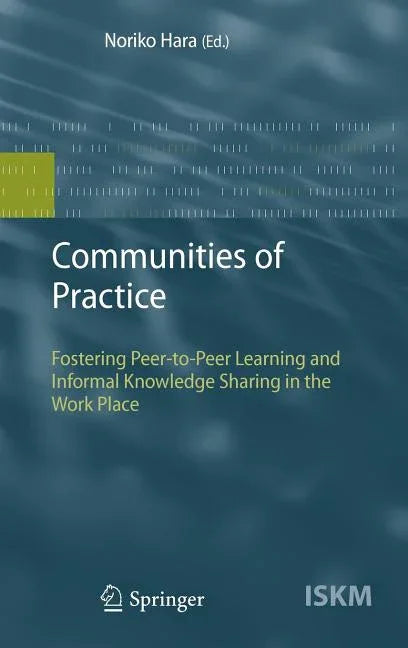
Communities of Practice: Fostering Peer-To-Peer Learning and Informal Knowledge Sharing in the Work Place (2009)
Communities of Practice: Fostering Peer-To-Peer Learning and Informal Knowledge Sharing in the Work Place (2009)
Regular price
$109.99 USD
Regular price
$114.99 USD
Sale price
$109.99 USD
Unit price
/
per
Shipping calculated at checkout.
In stock
Couldn't load pickup availability
1.1 Introduction Each year corporations spend millions of dollars training and educating their - ployees. On average, these corporations spend approximately one thousand dollars 1 per employee each year. As businesses struggle to stay on the cutting-edge and to keep their employees educated and up-to-speed with professional trends as well as ever-changing information needs, it is easy to see why corporations are investing more time and money than ever in their efforts to support their employees' prof- sional development. During the Industrial Age, companies strove to control natural resources. The more resources they controlled, the greater their competitive edge in the mark- place. Senge (1993) refers to this kind of organization as resource-based. In the Information Age, companies must create, disseminate, and effectively use kno- edge within their organization in order to maintain their market share. Senge - scribes this kind of organization as knowledge-based. Given that knowledge-based organizations willcontinuetobeadrivingforcebehindtheeconomy, itisimperative that corporations support the knowledge and information needs of their workers.
Product Information
Product Information
1.1 Introduction Each year corporations spend millions of dollars training and educating their - ployees. On average, these corporations spend approximately one thousand dollars 1 per employee each year. As businesses struggle to stay on the cutting-edge and to keep their employees educated and up-to-speed with professional trends as well as ever-changing information needs, it is easy to see why corporations are investing more time and money than ever in their efforts to support their employees' prof- sional development. During the Industrial Age, companies strove to control natural resources. The more resources they controlled, the greater their competitive edge in the mark- place. Senge (1993) refers to this kind of organization as resource-based. In the Information Age, companies must create, disseminate, and effectively use kno- edge within their organization in order to maintain their market share. Senge - scribes this kind of organization as knowledge-based. Given that knowledge-based organizations willcontinuetobeadrivingforcebehindtheeconomy, itisimperative that corporations support the knowledge and information needs of their workers.
Share